
Electric Motor Bearing Failure: 5 Common Causes and How to Prevent Them
Bearings are among the hardest-working components inside an electric motor. They support the rotor, maintain the air gap between rotor and stator, and handle thousands of RPM under load — hour after hour, shift after shift. When they fail, the motor goes down with them.
Electric motor bearing failure is responsible for an estimated 60 percent of all motor breakdowns in industrial settings. That makes it the single most common reason facilities in Columbus and central Ohio lose production time to motor problems. The frustrating part is that most bearing failures are preventable. They follow predictable patterns, give warning signs, and respond well to straightforward maintenance practices.
Here are the five most common causes of electric motor bearing failure and what your maintenance team can do about each one.
1. Lubrication Problems
Lubrication issues are the leading cause of bearing failure in electric motors. That includes not just under-greasing, but also over-greasing, using the wrong type of grease, and mixing incompatible lubricants.
Under-greasing starves the bearing of the film it needs to separate the rolling elements from the raceway surfaces. Metal-to-metal contact follows, generating heat, wear, and eventually pitting or spalling on the bearing surfaces.
Over-greasing is just as damaging but often overlooked. Too much grease creates internal pressure and excess heat. The grease churns instead of forming a protective film, and the bearing runs hotter than it should. Over time, the heat breaks down the lubricant itself, leaving the bearing worse off than if it had been left alone.
Prevention:
- Follow the motor manufacturer’s lubrication schedule. If no schedule exists, EASA standards provide recommended intervals based on motor speed, frame size, and operating environment.
- Use the specified grease type. Mixing lithium-based and polyurea-based greases, for example, can cause the mixture to harden or separate.
- Do not grease motors with sealed or shielded bearings that are designed to be lubricated for life.
- Use a grease gun with measured output rather than guessing amounts.
- Monitor bearing temperature with an infrared thermometer after greasing. A spike in temperature right after re-lubrication usually points to too much grease.
2. Misalignment
When a motor shaft is not properly aligned with the driven equipment — whether that is a pump, fan, conveyor, or compressor — the bearings absorb forces they were not designed to handle. Angular misalignment puts uneven load on the bearing, while parallel (offset) misalignment causes the shaft to deflect with each revolution.
In either case, the bearing wears unevenly and prematurely. Misalignment also shows up as vibration, increased noise, and higher operating temperature, all of which accelerate degradation.
Prevention:
- Use laser alignment during every motor installation or reinstallation.
- Re-check alignment after the motor reaches operating temperature. Thermal growth shifts the shaft position.
- Inspect the mounting base for soft foot — uneven contact between the motor feet and the base.
- Check coupling condition during alignment. A worn or damaged coupling can mask or introduce misalignment.
3. Contamination
Central Ohio facilities deal with a range of contaminants depending on the industry. Manufacturing floors produce metal shavings, grinding dust, and coolant mist. Food processing plants have washdown water and sanitation chemicals. Water and wastewater treatment plants operate in humid, corrosive environments.
When any of these contaminants reach the bearing — through damaged seals, improper storage, or during maintenance — they act like sandpaper between the rolling elements and raceways. Moisture is particularly harmful because it promotes corrosion on bearing surfaces, and even microscopic corrosion pits become stress concentrators that lead to spalling.
Prevention:
- Inspect and replace shaft seals on a regular schedule.
- Store spare motors and bearings in a clean, dry environment.
- During motor service, keep the work area clean and cover any openings that expose the bearing cavity.
- In washdown or high-humidity environments, consider upgrading to sealed bearings or adding supplemental shaft seals.
4. Electrical Damage From VFDs
Variable frequency drives have become standard equipment in modern facilities because of the energy savings and process control they provide. But VFDs introduce a problem that many maintenance teams do not account for: shaft currents.
A VFD produces a high-frequency switching pattern that induces a voltage on the motor shaft. If that voltage builds up enough to overcome the insulation of the bearing lubricant film, it discharges through the bearing in a tiny electrical arc. Each individual discharge is small, but they happen thousands of times per second. Over weeks and months, the accumulated damage creates a pattern called fluting — a series of parallel grooves etched into the bearing raceway that look like a washboard.
Once fluting develops, the bearing becomes noisy, vibration increases, and failure follows. This type of damage is becoming more common as VFD adoption grows, and it catches many facilities off guard.
Prevention:
- Install a shaft grounding ring or brush on motors driven by VFDs.
- Use insulated bearings (ceramic-coated outer race or hybrid ceramic rolling elements) on the drive end if grounding alone does not resolve the issue.
- Check for fluting damage during routine bearing inspections.
- Make sure the VFD is properly grounded and the cable between the drive and the motor is shielded and grounded at both ends.
5. Improper Installation
Even a perfect bearing will not last if it is installed incorrectly. The most common installation mistakes are using excessive force to press a bearing onto a shaft, heating a bearing unevenly before installation, and failing to support the correct race during press-fitting.
Another common oversight is replacing a failed bearing with a lower-grade substitute. Industrial motors often use C3-clearance bearings to accommodate thermal expansion during operation. Installing a standard-clearance bearing because it was available on the shelf leads to preloading once the motor heats up, which accelerates wear.
Prevention:
- Use an induction heater for uniform, controlled heating for interference-fit bearings.
- Always press on the race that carries the interference fit.
- Match the replacement bearing to the original specification, including clearance class, tolerance grade, and material.
- After installation, spin the shaft by hand and listen for roughness or binding before connecting the motor to its load.
The Role of Vibration Analysis and Predictive Maintenance

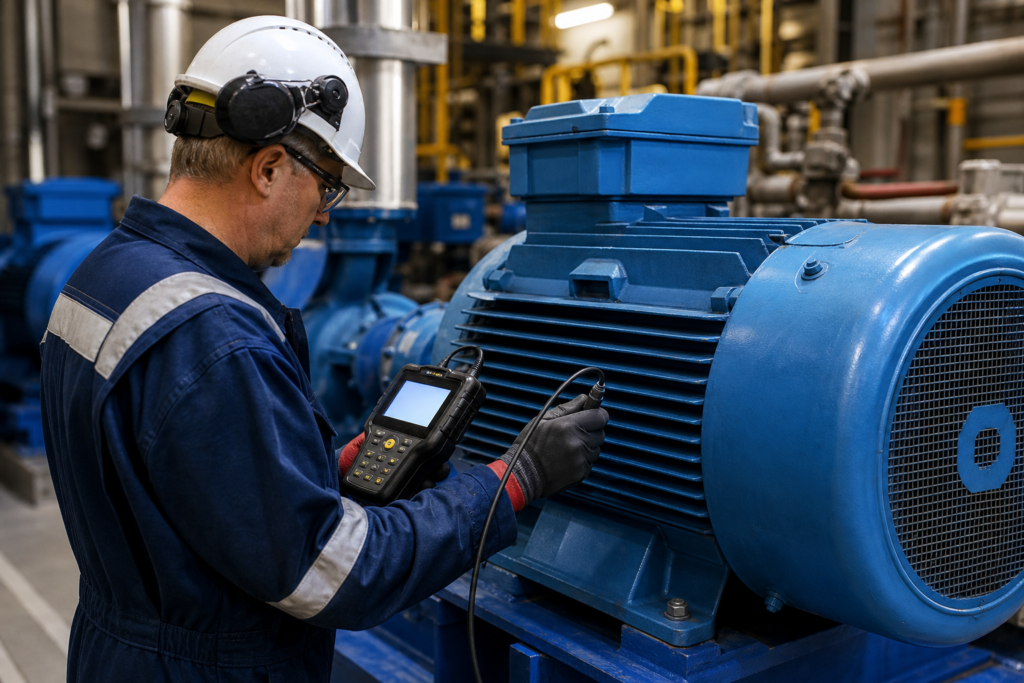
The five causes listed above account for the vast majority of bearing failures, but they share one thing in common: they all produce measurable vibration changes before the bearing actually fails. A bearing that is running dry, misaligned, contaminated, electrically damaged, or improperly installed will vibrate differently than a healthy bearing — and those vibration signatures are detectable well in advance of a breakdown.
Routine vibration analysis is one of the most effective tools for catching bearing problems early. Baseline readings taken when the motor is running well provide a reference point. When subsequent readings show characteristic frequency peaks associated with bearing defects — outer race, inner race, rolling element, or cage faults — your maintenance team has a window to plan a replacement during scheduled downtime instead of reacting to an emergency.
For facilities that run critical motors around the clock, adding vibration monitoring to your predictive maintenance program pays for itself quickly by avoiding a single unplanned failure.
When to Replace vs. When to Investigate Further
Not every noisy bearing means the motor needs to come out of service immediately. But certain signs call for prompt action:
- Increasing vibration levels that trend upward over consecutive readings
- Elevated bearing temperature that does not correspond to a change in load or ambient conditions
- Audible noise — grinding, squealing, or rumbling that changes with motor speed
- Visible grease leakage around shaft seals or bearing caps
- Metal particles in grease samples
If you find fluting damage, recurring premature failures, or bearing problems that keep coming back despite correct maintenance, the root cause may be outside the bearing itself — shaft damage, housing wear, structural vibration from nearby equipment, or an electrical issue from a VFD. A motor repair shop with diagnostic capabilities can investigate the full picture.
Keep Your Motors Running
Bearing failure does not have to be inevitable. The right lubrication practices, proper alignment, contamination control, VFD grounding, and careful installation address the root causes behind the vast majority of bearing failures in industrial motors.
For Columbus and central Ohio facilities that need bearing replacement, vibration analysis, laser alignment, or a thorough motor diagnostic, IER Services has the equipment and experience to get it done right. We handle everything from small fractional horsepower motors to large industrial units, and our predictive maintenance services help catch problems before they become production emergencies.
Call IER Services at (614) 298-1600 or contact us online to schedule a motor inspection or discuss a predictive maintenance program for your facility.