
Food Processing Electric Motor Repair in Central Ohio: A Plant Manager’s Guide

When a conveyor motor drops out mid-run, the clock starts running on your product’s lifespan. Temperatures drift, batches stall, and every minute the line sits costs you inventory and output you cannot make back later in the shift.
We repair motors, pumps, and drives for food processors across central Ohio from our shop, located at 1608 Clara St in Columbus. Food plants put unique stresses on a motor, and those stresses change how you should maintain the motor, as well as what to do in the case of failure.
Why Food Plant Motors Fail Faster
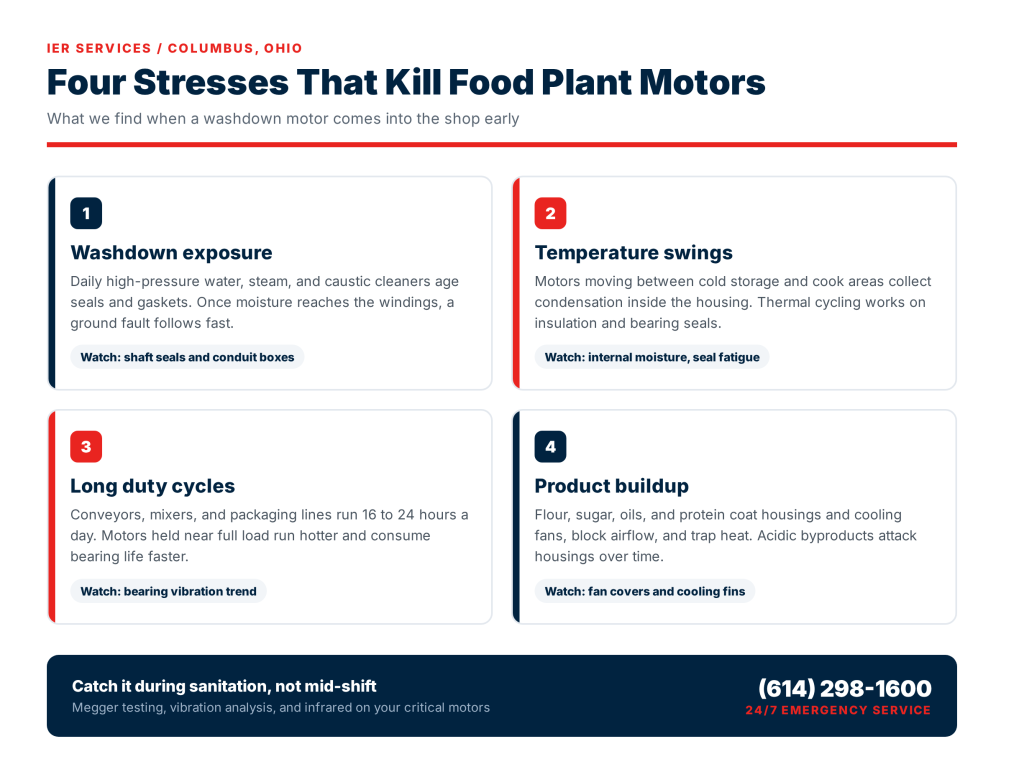
Washdown exposure comes first. Food plants clean equipment daily, sometimes several times a shift, with high-pressure water, steam, and chemical agents. A motor rated for washdown duty at NEMA 4X or IP66 still ages. Seals harden, gaskets compress, and small housing dings open a path. Once water or caustic cleaner reaches the windings, insulation breaks down and a ground fault quickly follows.
Temperature swings add condensation. Many plants run cold storage near freezing and cooking areas well above ambient temperatures. Motors that move between those zones, or sit at the boundary, can collect moisture inside the housing. Thermal cycling also works on winding insulation and bearing seals through constant expansion and contraction.
Duty cycles run long. Conveyors, mixers, grinders, and packaging equipment often run 16 to 24 hours a day. A motor held near full capacity for that long runs hotter and burns through bearings faster than you’d expect.
Product coats everything. Flour dust, sugar, oils, and protein build up on housings and cooling fans, block airflow, and trap heat. In some plants, acidic byproducts attack housings and shafts over time.
The Failures We See Most in Food Plants
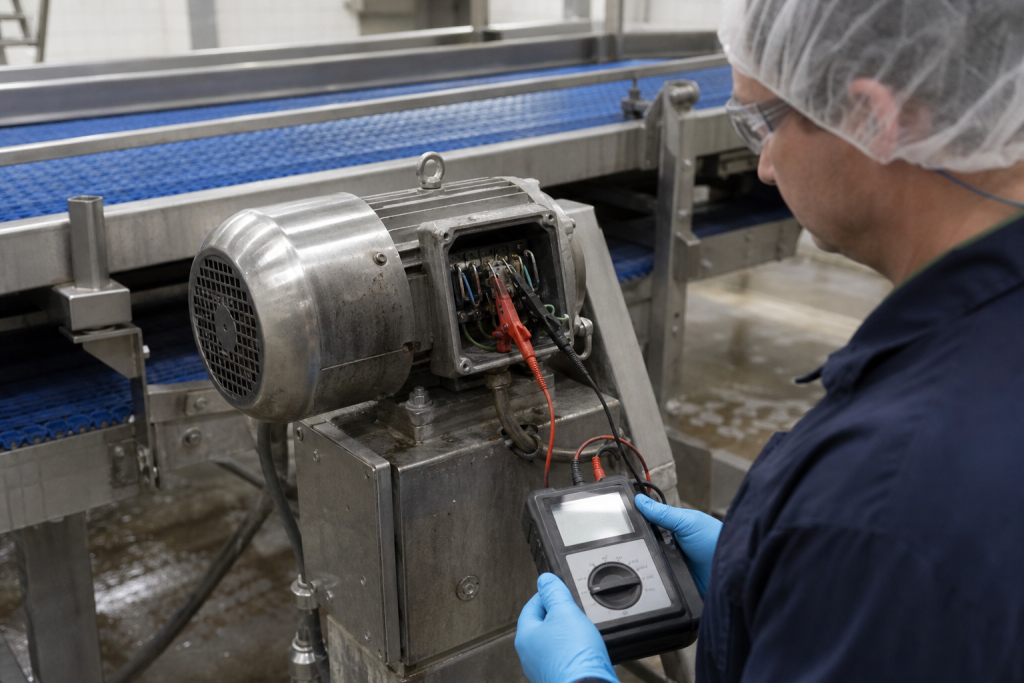
Winding insulation failure is the leading cause of burnout in food processing motors. Moisture plus heat cycling plus long run hours breaks insulation down faster than it would in a dry plant. Insulation resistance testing, which most crews call megger testing, tracks winding health across months. A reading that keeps dropping indicates you should schedule a rewind instead of waiting for the winding to let go mid-shift.
Bearing failure is next. Washdown moisture gets past the seals and into the housing, especially when spray hits the shaft seal head-on. Vibration climbs long before the noise does, so quarterly checks help to catch it early.
Shaft seals and gaskets are the barrier holding all of that back, and they are consumable. Inspecting them at every scheduled stop and replacing them before they weep is one of the cheapest habits a food plant can build.
VFD stress on windings hits motors running on variable frequency drives. Drives create voltage spikes that older insulation systems were never built for. Motors on VFDs should be wound with inverter-duty magnet wire meeting NEMA MG1 Part 31. If yours were not, a rewind with the correct wire class is worth doing during a planned outage.
Preventive Maintenance That Fits a Food Plant Schedule
The most expensive repair is the one that stops a line at peak production. A short list of habits prevents most of them.
Use your sanitation windows. You already shut equipment down to clean. That is the time to look for moisture in conduit boxes, worn seals, heat discoloration, and product buildup on cooling surfaces. It costs almost nothing.
Monitor the motors that matter. Three tools carry most of the value: vibration analysis for bearings and balance, infrared thermography for hot connections and overloaded motors, and megger testing for insulation trend. We run these on-site for food processors across central Ohio.
Stock spares for critical positions. Not every motor is equal. Find the ones whose failure stops a whole line, usually main conveyor drives, primary mixer motors, and refrigeration compressor motors, and keep tested spares on the shelf. When one fails you swap it, the line runs, and the failed unit goes out for a proper shop repair instead of a rushed patch.
Confirm insulation class on VFD circuits. Plants that added drives to existing motor circuits without checking inverter-duty ratings are carrying hidden risk. We can test the insulation class and rewind with VFD-rated wire on your schedule.
Repairing or Replacing a Washdown Motor
In food processing, one factor outweighs the rest: whether the motor is still fit for a sanitary, washdown environment.
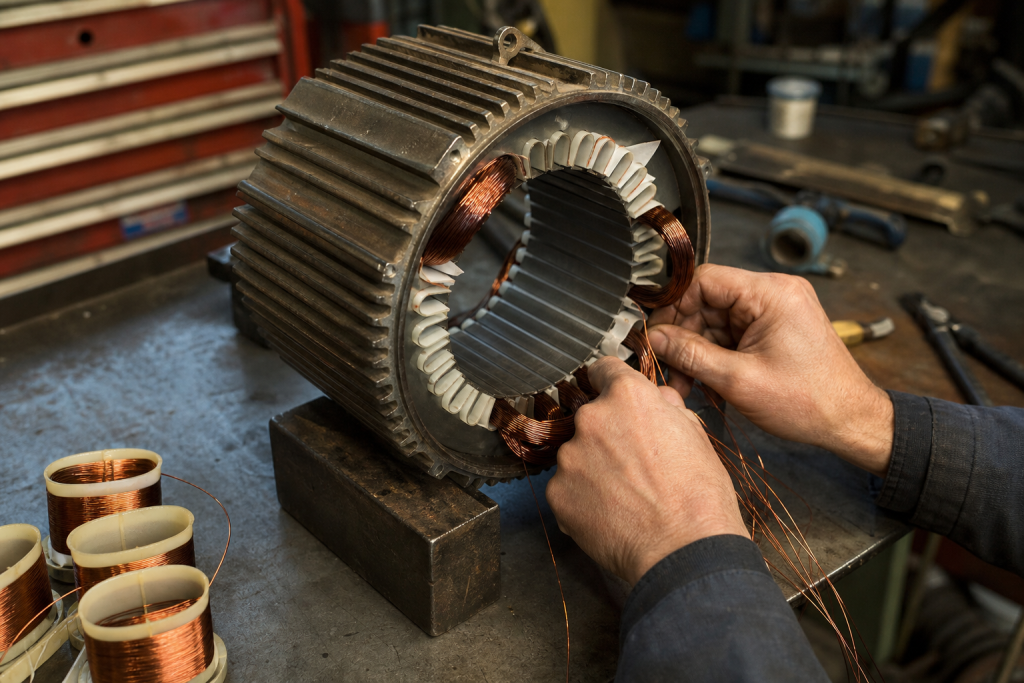
Repair is the right answer when the failure is contained to a bearing, a seal, or a winding, and the housing, shaft, and frame are sound with no serious corrosion. A quality rewind with upgraded insulation can leave a motor better than it came from the factory, and it beats waiting on a new washdown-rated motor that may carry several weeks of lead time.
Replacement is the call in specific cases. The housing may be corroded past the point where it will seal reliably. A premium efficiency upgrade may pay back through energy savings on a motor running long hours. Or the application has changed, and a standard TEFC motor now sits in a spot that needs true washdown capability.
We give you both numbers and the reasoning behind them. Our shop handles teardown, inspection, rewinding, machining, bearing replacement, dynamic balancing, and electrical testing under one roof, and we carry motor inventory, so neither choice will have you waiting on a subcontractor.
Working With IER Services
Our field team runs on-site diagnostics, bearing work, vibration analysis, and laser alignment at your facility when a motor cannot come off the floor. When it can, expedited bench repair at the Clara Street shop usually turns around the same day or the next business day, tested and verified before it goes back into service.
Emergency calls reach a live operator around the clock, not voicemail, and we dispatch from there. We work with all major motor, pump, and drive brands and are an authorized distributor for WorldWide Motors and Mitsubishi Drives, which shortens parts hunts when something has to move fast.
Keep your lines running. Call us at (614) 298-1600 for 24/7 emergency service, or get in touch to set up a motor inspection at your plant.
Frequently Asked Questions
How fast can you respond when a motor fails on our production line?
Our emergency line is answered by a live operator 24/7 and we dispatch a technician from that call. For plants in the Columbus area, field service is typically on-site the same day, and emergency bench repairs usually turn around the same day or the next business day.
Can you repair a washdown motor, or does it have to be replaced?
Most washdown motors can be repaired. If the housing, shaft, and frame are sound and the failure is a bearing, a seal, or a winding, a rewind with upgraded insulation restores the motor and often improves on the original. Replacement makes sense when corrosion means the housing will no longer seal reliably.
What is megger testing and how often should we do it?
Megger testing measures insulation resistance in the motor windings. The value is in the trend, not one reading. Quarterly or twice-yearly testing on critical motors shows insulation degrading months before it fails, which turns an emergency into a scheduled rewind.
Do we need special motors if our plant runs VFDs?
Yes. Variable frequency drives produce voltage spikes that standard insulation was not designed to handle. Motors on VFDs should use inverter-duty magnet wire meeting NEMA MG1 Part 31. If your motors predate the drives, we can test the insulation class and rewind them with the correct wire.
Do you come to our facility or do we have to ship the motor to you?
Both. We run on-site diagnostics, bearing replacement, vibration analysis, and laser alignment with fully stocked service vehicles. When a motor needs a rewind, machining, or full electrical testing, it comes to our shop at 1608 Clara St in Columbus.
Which industries do you work with besides food processing?
We serve manufacturing and OEM plants, agricultural operations, health care facilities, municipal water and wastewater treatment, and commercial buildings across central Ohio.