
Emergency Electric Motor Repair: How Central Ohio Facilities Cut Downtime
A motor quits at 2 a.m. and the line stops moving. Between that moment and when it runs again, you’re paying for idle crews, missed shipments, and product that doesn’t come off the line. What happens in the first hour determines whether this issue will become a half-shift problem or a three-day one.
We take emergency electric motor repair calls from plants, water treatment facilities, food processors, and building engineers across central Ohio. The facilities that recover fastest are the ones that proactively decided what to do before anything actually broke.
When You Need Emergency Electric Motor Repair
A backup pump motor that drops while the primary one keeps running can wait for a scheduled repair. A motor that is tied to output or safety needs more urgent repair. Treat it as an emergency when:
- Production stops. The failed motor is the reason the line is down.
- A safety system depends on it. Exhaust fans, vent systems, and fire pumps can’t sit in a queue.
- Perishable or reactive material is at risk. In food and chemical plants, a stopped motor can cost you the entire batch.
- Building systems are affected. HVAC motors failing in a heat wave or a cold snap put people and equipment at risk.
- There’s no backup. If nothing else can carry the load, any failure on that unit is urgent.
Rank your electric motors now, while nothing is broken. When a failure hits at 2 a.m., your on-shift lead should already know whether to call for emergency service or open a work order for Monday.
Emergency Motor Repair: The First 30 Minutes
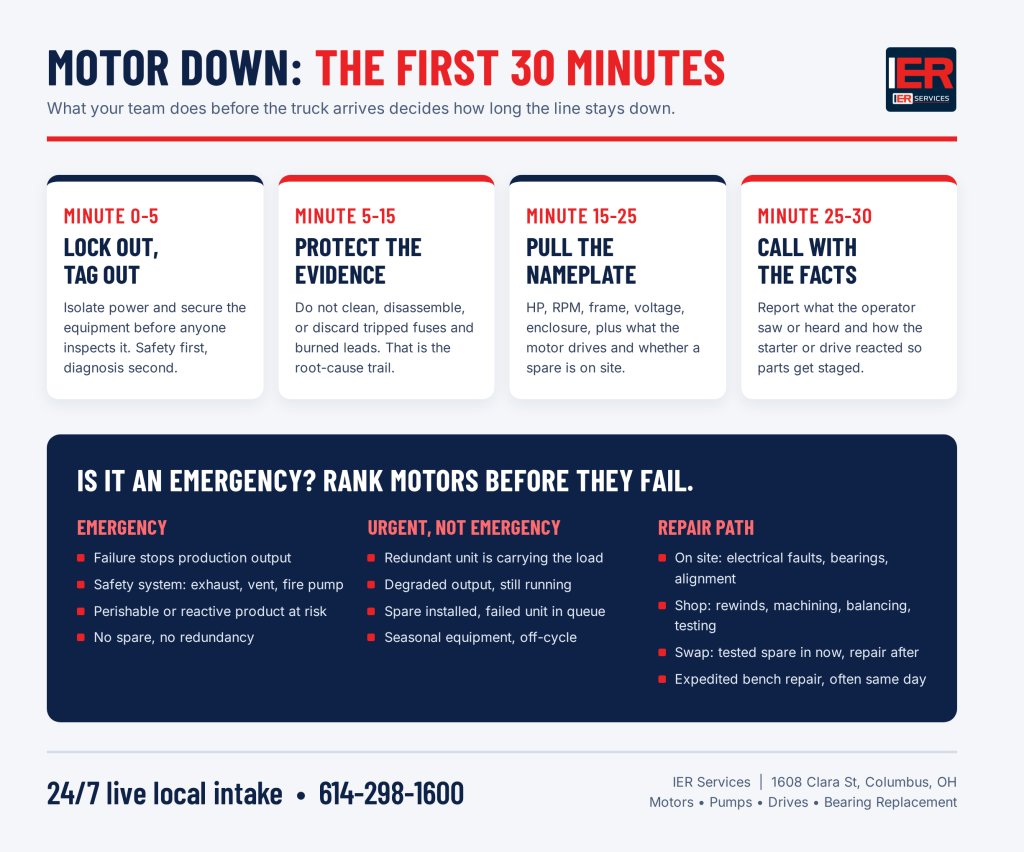
What your team does before we arrive determines how fast the repair goes. Lock out and tag out the equipment first, then protect the evidence. Don’t clean the motor, don’t pull it apart, and don’t discard a tripped fuse or a burned lead. Those details tell us why it failed, and hold data we need to prevent the failure repeating in the future.
Then collect what we’ll ask for on the call: full nameplate data (HP, RPM, frame, voltage, enclosure), what the motor drives, and whether a spare exists on site. Tell us what the operator saw or heard before it stopped and how the starter or drive responded. Having that ready before the call can cut diagnosis time significantly, because we can stage the right parts and the right technician before the truck leaves Clara Street.
On-Site Motor Repair, Shop Repair, or Swap
There are three options to use to get your process running again, and the right one depends on what the failure was and the how quickly it needs to be repaired.
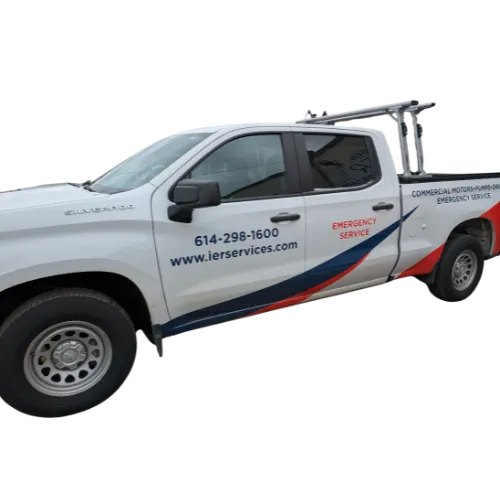
On-site field service fits when the motor is large or awkward to remove, or when the problem looks electrical: connections, leads, starter, drive. It also fits when a bearing replacement or alignment correction can be done in place. Our trucks carry diagnostic gear, common parts, and laser alignment tools, and many of these emergency motor repair calls finish the same day.
Shop repair fits when winding insulation has failed and the motor needs a rewind. It also fits when the shaft or bearing fits need machining, or when the unit needs balancing and full testing before it goes back in service. Our bench motor repair in Columbus is expedited for emergencies, and most jobs finish on the same day or next business day. Testing the motor before it is returned to you matters: a motor that goes back untested is a repeat failure waiting to happen.
Swap and repair is the fastest option for critical positions, and it only works if you are prepared. Keep a tested spare on the shelf, install it when the primary motor fails, and then send the failed unit in for a proper repair with normal turnaround time. Production can resume in hours, and the repaired motor becomes your next spare with no emergency repair required. For any motor whose failure will stop a line, the shelf cost is cheaper than one long shutdown.
What Causes Emergency Motor Failures
The emergency electric motor repair calls we run in central Ohio cluster around a short list of causes.
Bearings. Contamination, poor lubrication, misalignment, and belt overtension account for a large share of failures. They also announce themselves early through vibration and heat, which is why vibration monitoring catches so many bearing issues before a shutdown occurs.
Winding insulation. Heat, moisture, and voltage stress can break electric motor insulation down over time. Overloaded motors, restricted cooling, and dirty environments will speed up the process. Once a winding shorts out, you’re looking at a full rewind.
Power quality and controls. Voltage imbalance, single phasing, loose connections, and failed drive components take out motors that were otherwise healthy. When we see a motor fail young, the cause is often upstream of the motor itself.
Application drift. Loads change. A pump that now moves thicker product, or a fan pushing against a clogged filter bank, runs hotter than the motor was sized for. The nameplate stops matching the job, and the motor fails early.
Fewer Emergency Motor Repairs Next Year
You won’t prevent every failure, but you can move most repairs out of the 2 a.m. emergency column.
Build your critical electric motor list and spend your monitoring budget there. Run vibration analysis, infrared scans, and insulation resistance testing on those units on a set schedule. A bearing caught early is a planned four-hour job instead of an unplanned two-day one. Stock spares for your highest-priority positions and test them on a cycle so the spare works when you need it.
Pick your emergency repair partner before the call, not in the moment. Know the response time, confirm they answer live at night, and check that they stock parts for the motor types you run. After every emergency, spend fifteen minutes going over what failed, why, and whether that position needs monitoring or a spare kept on-site. Those notes are what shrink next year’s downtime.
Why Columbus Facilities Call Us for Emergency Motor Repair
Every electric motor we return to service is tested before it ships. Our intake team is local and answers live, 24/7, so you talk to a person who can dispatch right away instead of being sent to voicemail. Emergency calls go to the front of the line, our technicians are on call around the clock, and our trucks are stocked for field repairs. We carry replacement motors and pumps in stock, and when a field fix isn’t possible, the unit goes to an expedited bench repair. Our goal on every emergency is same-day back up and running.
Twenty-five years of work across manufacturing, municipal, medical, and commercial sites in central Ohio sits behind that. We’re also an authorized distributor for major motor and drive lines, which shortens sourcing when a replacement is the right answer.
FAQ
How fast can you respond to an emergency electric motor failure?
Calls are answered live 24/7 and emergency work is dispatched ahead of scheduled jobs. Our goal is same-day repair or replacement whenever the failure allows it.
Should I repair or replace a failed industrial electric motor?
It depends on the motor’s size, age, efficiency, and repair history. Large motors are usually worth repairing. Small motors with repeat failures often cost less to replace. We give you both numbers before work starts.
Can you repair a motor on site, or does it have to come to the shop?
Many electrical faults, bearing jobs, and alignment corrections are handled on site. Rewinds, machining, and balancing need the shop, where the motor is also tested before it goes back into service.
What information should I have ready when I call?
Nameplate data, what the motor drives, what happened right before it stopped, how the starter or drive reacted, and whether a spare is available. That lets us stage parts before we roll.
Do you keep replacement motors in stock?
Yes. We keep a large in-stock inventory of replacement motors and pumps, which often means a same-day swap while your original unit is repaired.
How do I stop emergency failures from repeating?
Find the root cause instead of only the broken part. Vibration analysis, thermal scans, and insulation testing on your critical motors turn most surprise failures into scheduled repairs.
Get Help Now
If a motor is down right now, call 614-298-1600 and you’ll reach a live local operator. If nothing is down today, that’s the better time to get in touch. We’ll help you build the critical motor list, the spares plan, and the monitoring schedule that protect your output and keep your next motor failure off the emergency board. Call 614-298-1600 or schedule service to get started.