
HVAC Motor Maintenance: How Central Ohio Facilities Can Avoid Costly Summer Breakdowns
Your HVAC system is working harder right now than at any other point in the year. Across central Ohio, commercial and industrial facilities are pushing their cooling systems to the limit as summer temperatures climb into the 90s — and the electric motors driving those systems are absorbing every bit of that strain. HVAC motor maintenance is the single most effective way to prevent an unplanned shutdown during the weeks when you can least afford one.
A failed HVAC motor in July does more than make people uncomfortable. In manufacturing environments, rising indoor temperatures can halt production lines, compromise product quality, and create dangerous conditions for workers. In food processing, cold chain integrity depends on continuous cooling. The cost of a single day of unplanned downtime can dwarf the cost of a proactive maintenance program many times over.
At IER Services, we work with facilities across Columbus and central Ohio to keep HVAC motors running through the most demanding months of the year. Here is what facility managers and maintenance teams need to know heading into the peak of summer.
Why Summer Is the Highest-Risk Season for HVAC Motors
HVAC motors face a compounding set of stresses during summer that they simply do not encounter the rest of the year. Understanding these stresses helps explain why so many motor failures cluster in June, July, and August.
Continuous duty cycles. During moderate weather, HVAC systems cycle on and off, giving motors periodic rest and allowing temperatures to stabilize. In the summer, systems often run continuously for hours or even full shifts without cycling down. This sustained operation pushes winding temperatures higher and keeps them there.
Elevated ambient temperatures. Motors are rated for specific ambient conditions — typically 40°C (104°F). When a motor sits in a rooftop unit, a mechanical room with poor ventilation, or near heat-producing equipment, the effective ambient temperature can exceed that rating. Every 10°C rise above the insulation class rating cuts the insulation life roughly in half.
Increased electrical load. Cooling demand drives higher amperage draws across blower motors, condenser fan motors, and chiller compressor motors. Motors that run near or above their rated full-load amps generate excess heat internally, compounding the thermal stress from ambient conditions.
Accumulated wear from the off-season. Motors that sat idle during spring may restart with dried-out lubrication, corroded connections, or moisture-damaged insulation. These latent issues often do not surface until the motor has been under sustained summer load for days or weeks.
Common HVAC Motor Failure Modes and What Causes Them
Not every HVAC motor failure looks the same. Recognizing the failure mode helps pinpoint the root cause and determine whether a motor needs repair, rewinding, or replacement.
Overheating and insulation breakdown. This is the most common failure mode, accounting for over half of all electric motor failures across industries. In HVAC applications, overheating is typically caused by restricted airflow across the motor (clogged filters, blocked coils), voltage imbalance, or sustained overloading. When winding insulation degrades, it creates short circuits between turns or phases, and the motor either trips its protection or burns out entirely.
Bearing failure. Bearings are the second most common point of failure. In HVAC motors, bearing problems are often caused by improper lubrication — either too much grease, too little, or the wrong type. Misalignment between the motor shaft and the driven load (belt sheaves, direct-coupled fans) accelerates bearing wear. You will typically hear grinding, squealing, or rumbling before a bearing fails completely.
Capacitor failure. Many single-phase HVAC motors rely on start and run capacitors. Capacitors degrade over time, especially in hot environments. A failed start capacitor prevents the motor from starting; a failed run capacitor causes the motor to run inefficiently, draw excess current, and overheat. Capacitor issues are common in rooftop units exposed to direct sun.
Electrical connection problems. Vibration, thermal cycling, and corrosion can loosen terminal connections over time. A loose connection creates resistance, localized heating, and eventually arcing damage at the terminal. In facilities with multiple rooftop units, connection problems are easy to overlook until a motor fails to start.
A Practical HVAC Motor Maintenance Checklist for Facility Teams
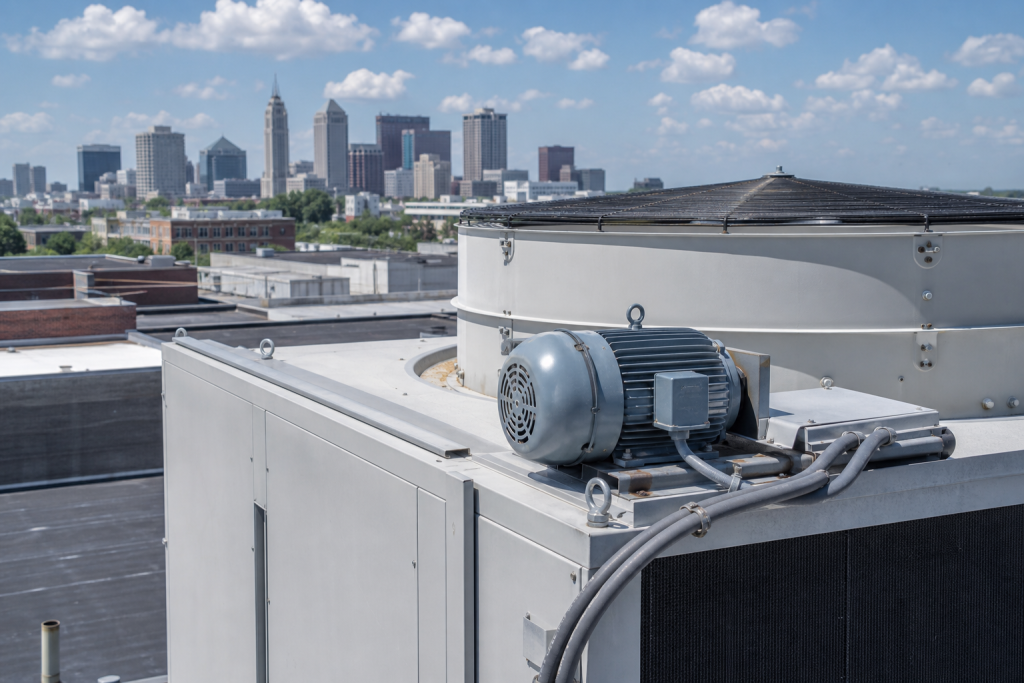
Proactive HVAC motor maintenance does not require specialized equipment for every task. Facility maintenance teams can handle many of these checks in-house, while others benefit from a qualified motor shop’s expertise.
What Your Team Can Do Monthly During Summer
- Inspect and replace air filters. Restricted airflow is the number one controllable cause of HVAC motor overheating. During peak summer, check filters every two to four weeks rather than monthly.
- Check belt tension and condition. Loose belts cause the motor to work harder; worn or cracked belts risk sudden failure. Look for glazing, fraying, and proper tension per the manufacturer’s specifications.
- Listen for unusual sounds. Grinding, squealing, or rhythmic knocking from a motor or fan assembly signals bearing wear, misalignment, or a loose component. Catching these early prevents cascading damage.
- Monitor motor temperature by touch or with an infrared thermometer. A motor that is too hot to hold your hand on for more than a few seconds is likely running above safe temperatures. An infrared thermometer provides a more reliable reading — compare it to the motor’s nameplate temperature rise rating.
- Verify that motor ventilation paths are clear. Dust, debris, and even pest nests can block cooling fins and fan covers. Clean the exterior of the motor housing and ensure nothing restricts airflow around the motor.
What a Motor Shop Should Handle Annually
- Insulation resistance testing (megger test). Measures the health of winding insulation and catches deterioration before it causes a failure.
- Vibration analysis. Identifies imbalance, misalignment, bearing wear, and looseness that visual inspection cannot detect.
- Bearing inspection and re-lubrication. A trained technician knows the correct grease type, quantity, and interval for each application.
- Electrical testing. Checking voltage balance, verifying amperage draw against nameplate ratings, and testing capacitors.
- Alignment verification. Laser alignment between the motor shaft and the driven equipment eliminates a major source of vibration and premature failure.
When Repair Makes Sense — and When It Does Not
When an HVAC motor fails, the immediate question is whether to repair, rewind, or replace. The right answer depends on several factors.
Repair is typically the best option when the failure is isolated to a specific component — a bearing, capacitor, or damaged lead — and the motor’s windings and frame are in good condition. A quality repair restores the motor to full performance at a fraction of the cost and lead time of a new motor.
Rewinding makes sense when the stator windings have failed but the rotor, bearings, shaft, and housing are sound. A proper rewind using quality materials restores the motor’s original efficiency and performance. For larger HVAC motors (25 HP and up), rewinding is almost always more cost-effective than replacement, especially when lead times for new motors can stretch weeks or longer.
Replacement is the better choice when the motor has been rewound multiple times, the frame is damaged, or the motor is an older standard-efficiency design and a premium-efficiency replacement would deliver meaningful energy savings over its remaining life.
IER Services helps facility managers work through this decision with honest assessments. We inspect every motor that comes through our shop and provide a clear recommendation based on what will deliver the best long-term value — not just the quickest sale.
Why Central Ohio Facilities Trust IER Services for HVAC Motor Work
Since 2011, IER Services has been the go-to motor shop for commercial and industrial facilities across Columbus and central Ohio. Our team handles everything from single-phase blower motors in rooftop units to large three-phase motors driving centrifugal chillers and cooling tower fans.
In-shop repair and rewinding. Our Columbus shop at 1608 Clara St is equipped for complete motor teardown, diagnostics, rewinding, balancing, and testing. We handle motors from fractional horsepower up through large industrial frames.
On-site field service. Not every problem requires pulling the motor. Our field service technicians bring diagnostic tools — including vibration analyzers and meggars — directly to your facility to assess motor condition, perform alignments, and handle repairs that can be completed in place.
Predictive maintenance programs. We work with facilities to establish vibration analysis baselines and scheduled testing programs that catch developing problems before they become emergency shutdowns. Predictive maintenance is especially valuable for HVAC systems with multiple motors spread across a building or campus.
Fast turnaround when it matters. We understand that a failed HVAC motor in July is an emergency, not a routine work order. IER Services prioritizes urgent HVAC motor repairs to get your cooling systems back online as quickly as possible.
Take Action Before the Next Heat Wave Hits
The best time for HVAC motor maintenance is before a failure forces your hand. If your facility’s HVAC motors have not been inspected this year, or if you are noticing warning signs — unusual noise, excessive heat, tripped breakers, or inconsistent cooling — now is the time to act.
Contact IER Services at (614) 298-1600 or visit ierservices.com to schedule an inspection, request a quote, or set up a predictive maintenance program for your facility. We are locally owned, centrally located in Columbus, and ready to keep your equipment running through the toughest months of the year.