VFD Installation for Columbus Manufacturing Facilities: What Your Team Needs to Know
If your facility still runs electric motors at full speed all day, you’re paying for energy and wear you don’t need. A VFD installation gives your team control over motor speed, startup current, and energy use across your operation. For manufacturers and processors across central Ohio, adding a variable frequency drive to existing motors is one of the fastest ways to cut costs and extend equipment life.
We install, retrofit, and upgrade VFDs for industrial facilities across the region. As an authorized distributor for Mitsubishi Drives and WorldWide Motors Drives, we match the right frequency drive to your motor and your process. Here’s what your team should know before, during, and after a VFD installation.
What a VFD Does for Your Electric Motors
A variable frequency drive controls motor speed by adjusting the frequency and voltage of the power it receives. Without a drive, your motor runs only one speed. It will pull the same current regardless of whether the load is heavy or light. That means wasted energy during slow periods and extra stress at startup.
With a VFD installed, you can control exactly how fast the motor spins. You can ramp it up slowly instead of slamming it to full speed right away. You can also slow the motor down when the process allows. This does three things right away:
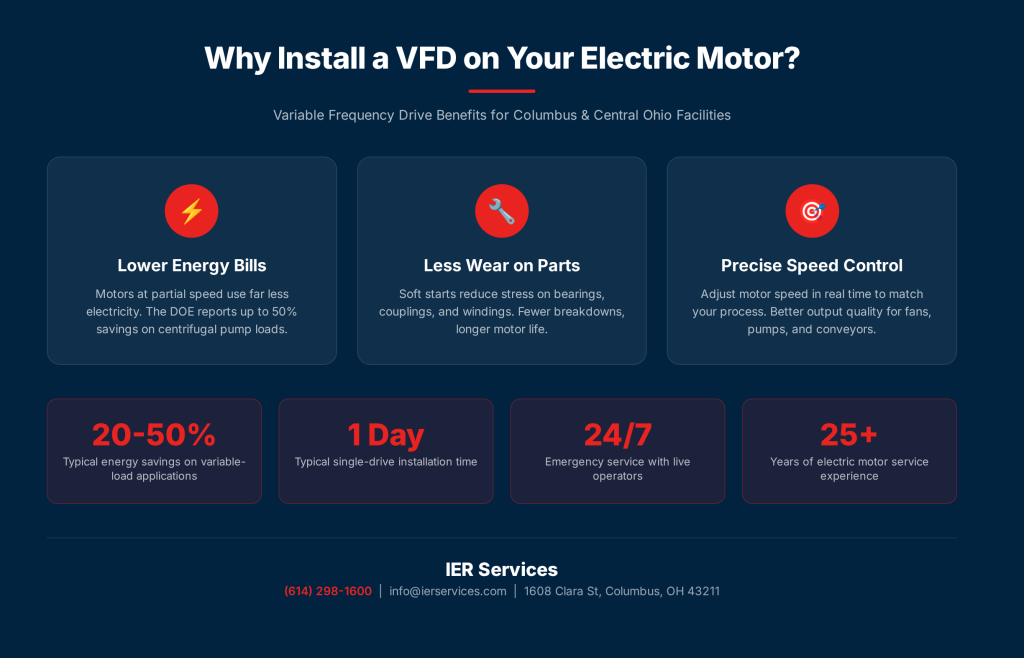
Reduced energy costs. Motors running at partial speed use less power than motors running flat out. The U.S. DOE notes that a pump motor cut from 100% to 80% speed can use roughly 50% less energy (due to the affinity laws for centrifugal loads). Over months, that adds up fast.
Less wear on parts. Hard starts are rough on your motor, your bearings, your couplings, and the load downstream. A VFD lets the motor ramp up slowly. That means fewer bearing swaps and longer gaps between repairs.
Precise process control. If your application needs variable flow, pressure, or speed, a VFD gives you smooth, accurate adjustment. Conveyor lines, fans, pumps, and mixers all benefit from speed control that matches the actual demand.
Signs Your Facility Needs a VFD Installation or Upgrade
You may already know you want a VFD on a specific motor. If you’re unsure, the signs that one is needed show up as maintenance problems or energy bills that don’t make sense. Here are the situations where we recommend a VFD installation:
High energy costs on large motors. If you’re running 25 HP or larger motors at constant speed for processes that don’t need constant output, a VFD can deliver meaningful savings. Fans, pumps, and blowers are the biggest opportunities.
Frequent motor failures or bearing replacements. Hard starts put heavy stress on motor windings and bearings. If a motor goes through bearings faster than expected, a soft-start VFD installation can reduce that wear and extend the motor’s service life.
Process quality issues tied to speed. Mixing, conveying, and pumping applications that need adjustable speed often run poorly at a fixed rate. A VFD gives your operators real-time control to dial in the right speed for each run.
Aging or failed starters. If your across-the-line or soft starter fails, replacing it with a VFD costs more upfront but gives you speed control, diagnostics, and energy savings you won’t get from another starter. When the old starter breaks, a VFD installation is often the better long-term investment.

Expansion or new equipment. Any time you add a motor to your operation or replace one, it’s the right time to evaluate whether a frequency drive should go on it.
How We Handle VFD Installation in Columbus
If you need VFD installation, Columbus, Ohio has several shops that do this work. Here’s what sets our process apart. Every VFD installation starts with an on-site assessment. Our technicians visit your facility, review the motor and the load it drives, and evaluate your electrical infrastructure. We check voltage, amperage, panel space, cable runs, and environmental conditions like heat, dust, and moisture.
From there, we select the right drive for the application. As an authorized Mitsubishi Drives distributor, we carry and install Mitsubishi VFDs. We also work with WorldWide Motors drives and have access to OEM-equivalent drives for replacement situations. The goal is matching the drive’s ratings and features to your motor and your process requirements.
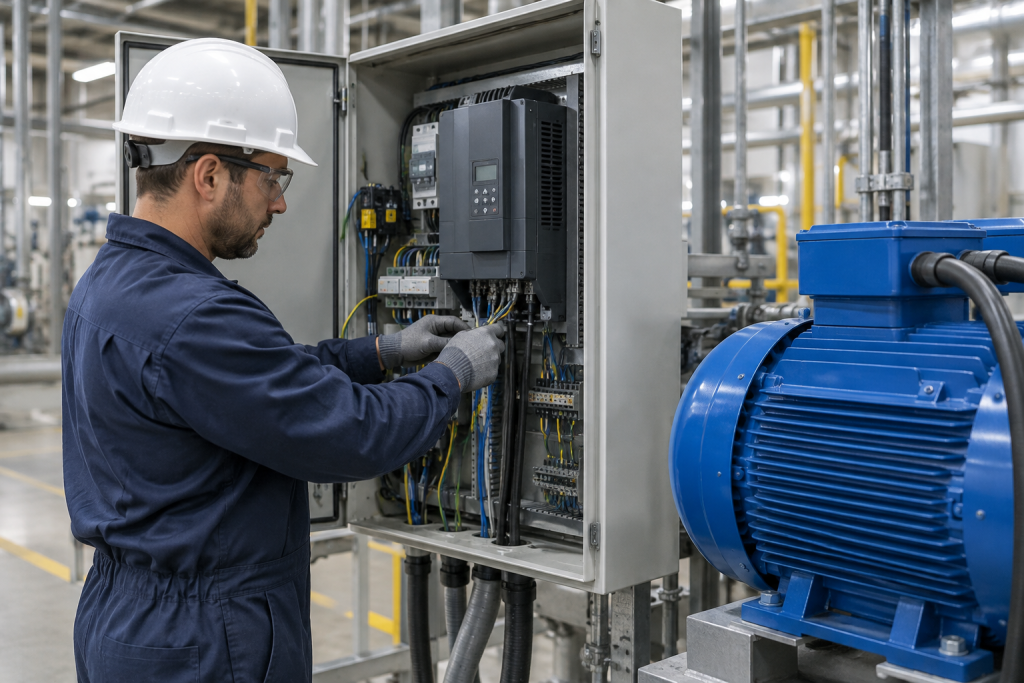
VFD installation includes mounting, wiring, programming, and testing. We set up acceleration and deceleration ramps, configure fault protection, and program any speed presets or control inputs your operation needs. Our goal is to optimize performance from day one. Before we leave, we run the motor under load and verify that vibration, temperature, and output are all within range.
For facilities that need drives installed on multiple motors, we work in phases to keep your production running. We schedule around your shifts and can handle after-hours and weekend work.
Choosing the Right Variable Frequency Drive
Not every VFD fits every motor. Choosing the wrong one leads to nuisance faults, overheating, or poor performance. Here’s what goes into the selection:
Motor horsepower and voltage. The drive must match your motor’s rated HP and voltage. Oversizing by one frame is common practice for applications with high starting torque or frequent cycling.
Load type. Constant-torque loads like conveyors and positive displacement pumps need a different drive setup than variable-torque loads like centrifugal fans and pumps. The drive’s current rating and control mode must match.
Environment. A VFD in a clean, air-conditioned electrical room has different requirements than one mounted near a washdown area or a dusty processing floor. Enclosure rating, cooling method, and filter options all depend on where the drive will live.
Communication and controls. If the drive needs to talk to a PLC, BMS, or other system, the protocol matters. Most modern drives and VFDs support Modbus, Ethernet/IP, and other protocols. We set these up during VFD installation so the drive works with your current controls.
Harmonics and power quality. VFDs can push harmonic noise back into your wiring. For plants with sensitive gear or many frequency drives on one supply, we check whether line reactors, DC chokes, or filters are needed.
What to Expect After VFD Installation
Once your new drive is running, you should notice a few things right away. The motor starts quietly instead of thumping to life. Energy monitoring (if you have it) will show lower draw during partial-load periods. Your operators will have speed adjustment available from the drive keypad or your control system.
Maintenance after installation is simple. Keep the drive’s vents clear and clean the fans or filters on a set schedule. Most drives and VFDs have a display showing fault codes and run data. We train your team on what to watch for and how to read the drive’s status.
Common questions from operators usually involve speed setpoints and fault resets. We provide documentation for each drive we install and walk your team through daily operation during commissioning.
When something goes wrong, our team responds fast. We offer 24/7 emergency service answered by live operators. If the drive faults and your maintenance team can’t resolve it, call us at (614) 298-1600. We troubleshoot on-site and carry common replacement parts. For drives that need bench repair, we offer expedited same-day service in most cases.
Over time, we recommend adding your new VFDs to a regular maintenance and testing schedule. Vibration analysis and thermal scans help catch problems early and keep your drives and motors running together for years. If a drive does need VFD repair down the road, we handle that too, with expedited bench service in most cases.
Frequently Asked Questions
How long does a VFD installation take?
A single-drive installation on an existing motor typically takes one day, including assessment, mounting, wiring, programming, and testing. Larger projects with multiple drives may take several days, and we schedule around your production to avoid downtime.
Will a VFD work with my existing motor?
In most cases, yes. Standard AC induction motors work well with VFDs. Some older motors or specialty windings may need evaluation. We check your motor’s insulation class and bearing type during the assessment to confirm compatibility.
How much can I save on energy with a VFD?
Savings depend on the application and how often the motor runs at less than full load. For centrifugal pumps and fans that vary with demand, the DOE estimates energy reductions of 20% to 50% are typical based on the affinity laws. We can estimate your savings based on your motor size and operating profile.
Do you install VFDs from brands other than Mitsubishi?
Yes. While we’re authorized distributors for Mitsubishi Drives and WorldWide Motors Drives, we install and service drives from all major manufacturers. We also have access to OEM-equivalent drives for retrofit and replacement situations.
What happens to my motor’s warranty if I add a VFD?
Adding a properly sized and installed VFD should not void your motor warranty in most cases. We follow manufacturer guidelines for installation and programming to keep your warranty intact. Reducing hard starts and controlling speed can also extend the motor’s usable life, so you may see fewer warranty day claims over time.
Can you retrofit a VFD onto a motor that currently uses an across-the-line starter?
Yes. Retrofitting is one of the most common VFD installations we do. We remove the existing starter, install the drive, and wire it into your existing motor circuit. The motor, wiring, and disconnect can often stay in place.
Get Your VFD Installation Started
You’ll get lower energy bills, smoother startups, and longer motor life from a single upgrade. For VFD installation in Columbus or anywhere in central Ohio, get in touch to schedule an on-site assessment. Call us at (614) 298-1600 or email info@ierservices.com. We’ll look at your motors, pick the right frequency drive VFD for each one, and give you a clear plan with pricing. We’re available 24/7 with live operators for urgent needs.