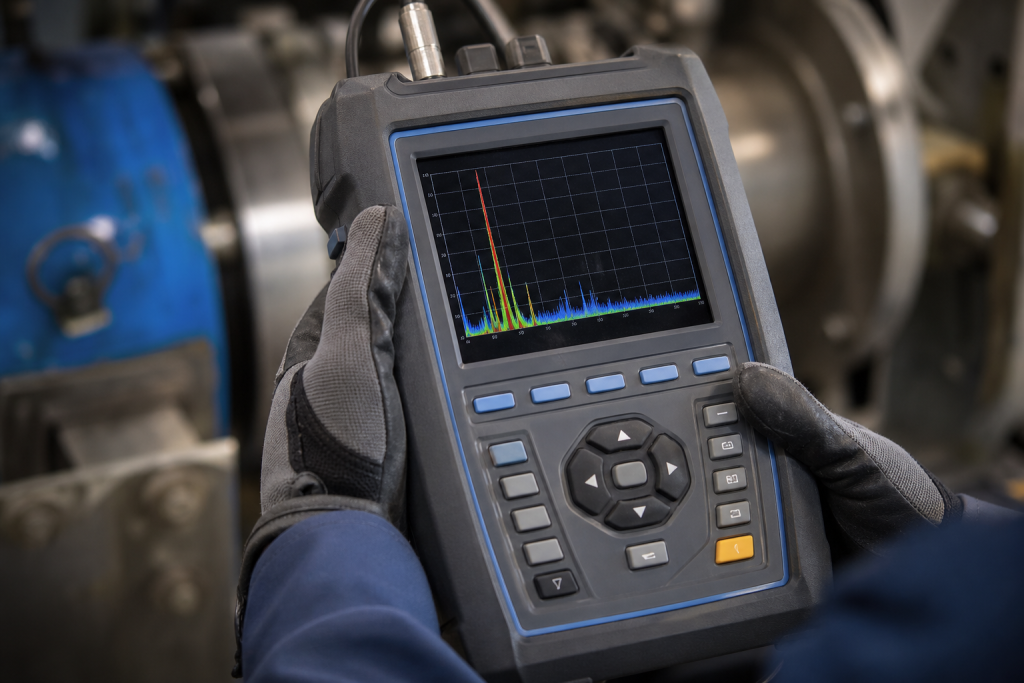
Vibration Analysis Electric Motor Testing: A Guide for Columbus Facilities
Electric motors vibrate during normal operation, that’s expected. But when vibration levels start to climb, something is likely going wrong inside the machine. Vibration analysis electric motor testing gives you a way to find those problems early, while they’re still small and cheap to fix.
We perform vibration analysis on industrial and commercial motors for facilities across Columbus and central Ohio. Here’s what your team needs to know about this type of testing, when to use it, and how it protects your equipment.

How Vibration Analysis Electric Motor Testing Works
Vibration analysis involves measuring how a running motor moves. A technician places sensors at key points on the motor housing. Those sensors record the captured vibration signal, showing how fast and how far the motor shakes.
A healthy motor vibrates in a consistent, low-level pattern. When parts wear or shift, that pattern changes. Each type of problem creates a distinct signature. A worn bearing produces high-frequency spikes, whike a bent shaft shows up at running speed, and an out-of-balance rotor creates a strong pulse once per turn.
Most motor failures build over weeks or months. Vibration testing catches them during routine checks, giving your maintenance team time to plan repairs on your schedule.
Problems You Can Catch with Vibration Analysis
High vibration readings indicate real problems. Here are the most common ones we find:
Bearing wear and defects rank as the top failure point in electric motors. As bearing surfaces degrade, they create distinct high-frequency patterns that show up clearly in vibration data. Catching these early gives your team time to order parts and schedule a bearing replacement before the motor locks up.
Rotor imbalance shows up as strong vibration at the motor’s running speed. Material buildup, broken rotor bars, or uneven wear can all throw a rotor out of balance. Left alone, this speeds up bearing wear and can damage the housing and mounts.
Shaft misalignment between the motor and the load it drives creates vibration in telltale patterns. This is one of the most common reasons motors fail early, and is also one of the easiest problems to fix once you know it’s there.
Loose mounting or base problems allow too much movement during operation. Vibration data reveals a soft foot, loose bolts, and worn mounting structures that other inspections miss.
Electrical faults like uneven air gaps, broken rotor bars, and stator winding issues show up as vibration at set frequencies. These are hard to detect any other way until the motor starts losing power.
When to Schedule Vibration Analysis for Your Electric Motors
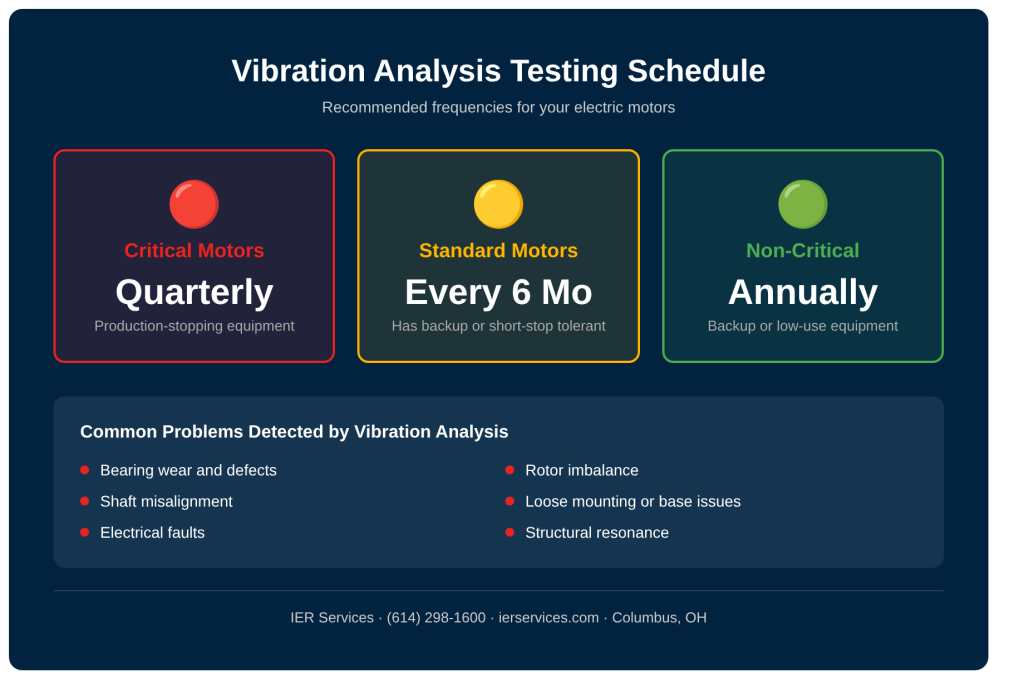
How often you test depends on how important each motor is to your operation. Here’s what we suggest to our central Ohio customers:
Critical production motors should get tested quarterly. If one of these motors goes down, your line stops. Quarterly checks give you enough data points to spot trends and catch problems that develop fast.
Standard process motors do well with testing every six months. These run your operation but have backup or can handle a short stop.
Non-critical or backup motors need at least one test a year. Even low-use equipment should have a baseline reading and a yearly check.
Beyond your regular schedule, test any motor that sounds different than normal, runs hotter than expected, or was recently repaired. Post-repair vibration testing confirms that the work was done right and the root cause was addressed.
How This Testing Saves You Money
An unplanned motor failure costs more than a planned repair. Often a lot more. The difference results from a few different factors:
Emergency repairs carry rush charges for parts, labor, and shipping. A planned repair avoids those premiums.
Downtime costs vary, but for most plants, an unplanned shutdown costs far more per hour than planned work during a set window.
A failing motor can wreck the parts it’s linked to: couplings, gearboxes, and driven loads. What starts as a bearing issue can turn into a full rebuild.
Running a motor with developing problems wears out every part faster. Regular vibration analysis helps you get the full useful life from your motors and avoid early replacement.
For most facilities, a quarterly testing program pays for itself the first time it catches a problem before it shuts down a line.
What to Expect During a Vibration Analysis Visit
If this is your first time scheduling vibration testing, here’s how it works:
We bring portable analyzers and place sensors at standard measurement points on each motor. If you haven’t had testing before, we set up baseline readings for future comparison.
Each motor takes about 15 to 30 minutes to test. Motors need to be running under normal load for accurate results. We work around your production schedule so there’s no downtime needed.
After testing, we analyze the vibration data and compare it to industry standards and your baseline. You get a clear report showing each motor’s condition, any developing faults, and what to do about them.
For motors that show early signs of trouble, we give you a specific repair plan with a timeline. We schedule repairs at your convenience, including after-hours and weekends. With over 25 years of experience in electric motor service, our team works on all major brands and sizes.
Frequently Asked Questions
How long does vibration analysis take for each motor?
Most motors take 15 to 30 minutes to test. Larger motors or those in tight spaces may need more time. We test during your normal hours and work around your operations so there’s zero downtime.
Can you perform vibration analysis on-site at our facility?
Yes. We bring portable equipment to your location in Columbus and across central Ohio. Your motors stay in service during the entire process.
What size motors can you test?
We test motors of all sizes. From small fractional HP units to large industrial motors, our gear and process cover them all.
How often should we schedule vibration testing?
For critical motors, quarterly. For standard process motors, every six months. For backup or non-critical motors, once a year. We can help you sort your motors into these groups based on your operation.
Is vibration analysis a standalone service, or does it come with repairs?
We offer it on its own as a predictive care service. Many of our customers run regular testing programs to track motor health over time, with no tie to repair work.
What happens if you find a problem?
We document the issue in your report with a severity rating and a recommended repair timeline. For urgent issues, we discuss your options right away, whether that’s on-site repair, a shop repair at our Columbus facility, or a bearing replacement. For slower-developing problems, we help you plan around your production schedule.
Protect Your Production with Regular Vibration Testing
Regular vibration analysis keeps your motors running longer and your production on track. You catch bearing wear, imbalance, alignment problems, and electrical faults before they cause shutdowns and emergency repair bills.
Get in touch to set up a testing program for your facility. Call us at (614) 298-1600 or email info@ierservices.com. We serve Columbus and central Ohio, and we’re available 24/7 with live operators for urgent situations.